














NEWS: Chatbots.org survey on 3000 US and UK consumers shows it is time for chatbot integration in customer service!read more..
 | by Karolina Kuligowska on Mar 2, 2012 in Research News |
Summary: Chatbots can improve your mental health by preventing and treating depression
The idea of a conversational artificial intelligence therapist is as old as ELIZA, the very first chatbot created in 1966, which emulated a client-centered therapy approach. New research on conversational agents revealed their effectiveness as Internet-based intervention tools that treat and even prevent depression.
Read more about: Chatbots: innovative treatment for depression
| by Reza Etemad-Sajadi on May 30, 2013 in Agent's Capabilities, Sales, Research News |
Summary: by R. Etemad-Sajadi, PhD
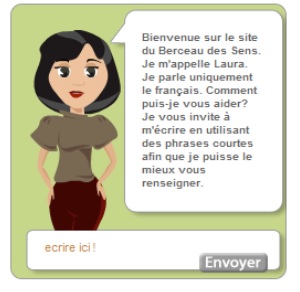 Research conducted by Ecole hôtelière de Lausanne (EHL) monitored what happened when a virtual agent was introduced to the website of it restaurant ‘Berceau des Sens’. We developed ‘Laura’ with the help of a computer service company named Askom. Laura is able to answer frequently asked questions, such as on menus and prices, making bookings, restaurant location, and opening hours; together with some more tricky queries, such as on children’s or special menus, and parking and Wi-Fi availability.
Read more about: How a virtual agent can attract real customers: A restaurant case study
 | by Erwin van Lun on May 11, 2009 in Chatbots.org news, Chatbots.org News |
Summary: The transformation of chatbots.org to a worldwide business community of chatbot developers
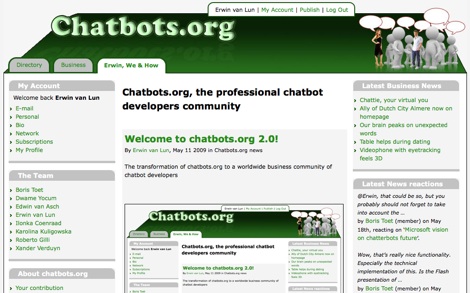 After months of hard work, we’re delighted to announce the new version of chatbots.org, creating a, in our opinion, world-class community platform for professional chatbot developers. We’re glad we’ve managed to implement so many wishes of chatbot developers world wide and we’ve added lots of functionality that we believe advances the chatbot community across the world.
Please read on about our tightened mission, the new functionality, new content, the history, the community, the future, and how your participation could help you create success, learn and get in touch with professional partners.
| by Erwin van Lun on Feb 2, 2010 in Research News |
Summary: Call for papers: Adaptation and Personalization in E-B/Learning using Pedagogic Conversational Agents

The benefits of the personalization and adaptation of computer applications to each user have been widely reported in recent decades. Educational applications are not an exception, both in e-learning, i.e. the use of electronic media to teach or assess, and b-learning blended learning), i.e. to combine traditional face-to-face instruction with electronic media.
Pedagogic Conversational Agents (PCAs) can be defined as virtual characters, which can teach or be taught by students in a domain, and even to serve as learner companions to void the so-called isolation problem of computer-based education. PCAs can be animated, and may consist only of a face, or have a full body (embodied conversational agents). Given that the educational application keeps a learner model, the PCA could use this to adapt the information presented to the user. It is therefore expected that the interaction will not only be more natural, but also more efficient, because it will be focused on the needs and preferences of each student.
Call for papers: International Workshop on Adaptation and Personalization in E-B/Learning using Pedagogic Conversational Agents June 21th, 2010, Hawaii, USA.
Read more about: Call for Papers: Pedagogic Conversational Agents
 | by Hunter Steele on Mar 29, 2010 in Agent's perception of humans, Speech recognition, Research News |
Summary: cassandra, a speech conversational agent (recognition & synth), a hamlet expert, SpeechTek Europe 2010 participan
Cassandra is our “Figure of Speech”, a title that nicely represents who and what she is. ejTalk’s mission from the very beginning has been to focus on the basic elements of conversation instead of developing products to accomplish a singular task. Most conversational agents today serve a particular purpose. They talk about specific topics but do not communicate in very conversational ways.
ejTalk takes the opposite approach with Cassandra by laying a foundation for the basic principles of day-to-day speech that will one day allow her to talk about anything. Take the example of a greeting: There are many ways to introduce oneself to another person. We may say “hello” to a person we have just met, but to a friend we will say “hey” or “hi.” It may seem like a trivial distinction, but to the human ear, the effect is highly noticeable.
Cassandra’s entry in the SpeechTEK Europe Avatar Challenge.
| by Karolina Kuligowska on Apr 21, 2011 in Agent's Processing, Emotion, Learning, Research News |
Summary: Basing on "regret" algorythm, computers are able to optimize experienced emotions.
 Researchers from Blavatnik School of Computer Science at Tel Aviv University led by Professor Yishay Mansour are developing artificial intelligence algorithm in order to equip machines with human emotions. According to this algorithm based on machine learning, the computer programs are taught a sense of “regret” and how to “feel sorry” for their mistakes.
Read more about: Emotive computers experience virtual remorse
| by Karolina Kuligowska on Jun 1, 2011 in Agent's perception of humans, Facial coding, Physiognomics, Research News |
Summary: Scientists on the trail of automatic human emotion recognition
According to scientists, it is possible that computers understand human emotional state. The algorithm allowing computers to recognize real person’s emotions and feelings will be used in fields such as biomedicine, law enforcement and computer science.
| by Karolina Kuligowska on Jun 6, 2011 in Agent's perception of humans, Neuroscience, Research News |
Summary: Neuro Breakthroughs: computers detect human thoughts
Researchers from Washington University School of Medicine in St. Louis have recently demonstrated that a computer can decode brain signals to infer the intentions of a human thoughts. From now on, people can “talk within their minds” to a computer in order to control it. How the act of human mind reading, usually associated with science-fiction literature, is actually possible?
Read more about: Can artificial limbs be controlled by mind-reading computers?
| by Karolina Kuligowska on Jul 11, 2011 in Agent's Processing, Emotion, Research News |
Summary: Virtual characters can recognize human emotions in real-time
Researchers from Human Centered Multimedia at the University of Augsburg developed a virtual character which is capable of recognizing and displaying the emotion of a user.
Read more about: Affective listener Alfred is full of empathy for the human emotions
| by Karolina Kuligowska on Jul 14, 2011 in Applications, User Client Technology, Research News |
Summary: Children and youth create conversational characters for 3D virtual environment Zora
Don’t be surprised if your child creates his/her first conversational agent earlier than you! Researchers from DevTech Research Group at Tufts University made it possible…
Read more about: Chatbots that even a child can enjoy making!